Most In-Demand Machine Learning Skills 2026: Tools to Learn
The most in-demand machine learning skills for 2026: the languages, frameworks, MLOps and deployment tools UK employers want, and how to learn them.
Machine learning is no longer confined to academic research—it's embedded in how UK companies detect fraud, recommend content, automate processes & forecast risk. But with model complexity rising and LLMs transforming workflows, employers are demanding new skills from machine learning professionals.
Welcome to the Machine Learning Jobs Skills Radar 2026—your annual guide to the top languages, frameworks, platforms & tools shaping machine learning roles in the UK. Whether you're an aspiring ML engineer or a mid-career data scientist, this radar shows what to learn now to stay job-ready in 2026.
Why are machine learning skills evolving in the UK in 2026?
In 2026, UK companies expect machine learning professionals to:
Build reproducible, explainable and optimised models
Understand full-lifecycle workflows: from data ingestion to CI/CD for ML
Apply models in real-world scenarios—under constraints of latency, ethics and cost
Collaborate across software engineering, data, DevOps, and compliance
Employers aren’t just hiring based on Kaggle scores. They want production-ready ML skills.
What are the top programming languages for machine learning in 2026?
1. Python
What it is: The backbone of ML research, development, and deployment.
Why it matters: Nearly every ML and deep learning framework is Python-first.
Used by: DeepMind, Babylon, Meta AI, government AI teams.
Roles: Machine Learning Engineer, Research Scientist, Data Scientist.
Skills to pair: NumPy, pandas, scikit-learn, TensorFlow, PyTorch, MLflow, FastAPI.
2. R
Where it fits: Statistical computing and classical ML, particularly in health, academia, and government.
Used by: NHS, NICE, biostatistics teams, academic AI researchers.
Roles: Statistician, Clinical AI Scientist.
Skills to pair: caret, glmnet, ggplot2, rmarkdown.
3. SQL
Why it matters: Essential for feature extraction, data cleaning and model monitoring.
Used by: Every data & ML engineering team.
Skills to pair: dbt, CTEs, materialised views, warehouse optimisation.
4. Scala / Java
Where they fit: Backend model serving, Spark MLlib, real-time inference pipelines.
Used by: Fintech platforms, recommendation systems, streaming analytics.
Roles: Real-Time ML Engineer, Data Engineer with ML.
Which core ML libraries and frameworks should you learn in 2026?
1. scikit-learn
What it is: Python's go-to library for classical machine learning models.
Why it matters: Essential for regression, classification, pipelines, and model evaluation.
Used by: SMEs, fintechs, education, forecasting systems.
Skills to pair: GridSearchCV, cross_val_score, SHAP integration.
2. XGBoost / LightGBM / CatBoost
What they are: Gradient boosting libraries that outperform deep learning on tabular data.
Why they matter: Still dominate tabular modelling in finance, insurance and pricing models.
Used by: Aviva, Barclays, Wise, actuarial tech.
Roles: Risk Analyst, Applied ML Engineer.
Skills to pair: Feature engineering, early stopping, SHAP, hyperparameter tuning.
3. TensorFlow & PyTorch
What they are: Leading frameworks for deep learning and neural networks.
Why they matter: Used in everything from NLP and vision to audio, LLMs, and reinforcement learning.
Used by: DeepMind, AstraZeneca, TikTok UK, Vision Labs.
Roles: Deep Learning Engineer, AI Scientist.
Skills to pair: CNNs, RNNs, Transformers, model compression, ONNX.
4. Hugging Face Transformers
What it is: Model hub + toolkit for fine-tuning NLP and multimodal LLMs.
Why it matters: Widely used for deploying GPT/BERT models into production.
Used by: Fintech chatbots, legal tech, journalism AI.
Skills to pair: Tokenisation, fine-tuning, prompt engineering, model deployment.
5. LangChain / LlamaIndex
What they are: Frameworks for building apps that connect LLMs to structured or private data.
Why they matter: Key for retrieval-augmented generation (RAG) workflows.
Used by: Startups building internal copilots and GenAI dashboards.
Skills to pair: Pinecone, Qdrant, vector embeddings, OpenAI API.
Which MLOps tools enable production-ready machine learning in 2026?
1. MLflow
What it is: Open-source tool for model tracking, versioning, and deployment.
Why it matters: Brings structure and traceability to ML experimentation.
Used by: Databricks clients, NHS MLOps teams, cloud ML pipelines.
Roles: ML Engineer, MLOps Developer, Model Governance Analyst.
Skills to pair: MLflow Tracking, Registry, Model Serving.
2. DVC (Data Version Control)
What it is: Git-like tool for datasets, models and pipelines.
Why it matters: Adds reproducibility to ML workflows, especially in teams.
Used by: Model teams in health, logistics and finance.
Roles: ML Ops Engineer, ML Research Ops Lead.
Skills to pair: Git, pipelines, metrics tracking.
3. Kubernetes + KServe / Seldon Core
What it is: Container orchestration and model serving in scalable environments.
Why it matters: Enables real-time inference and autoscaling.
Used by: AI-first companies, ML teams serving live predictions.
Roles: Infrastructure ML Engineer, Platform AI Lead.
4. Weights & Biases
What it is: Experiment tracking and visualisation dashboard.
Why it matters: Popular with deep learning research teams for model monitoring and collaboration.
Skills to pair: wandb integration, sweep tuning, real-time dashboarding.
5. FastAPI / Flask
What it is: Python web frameworks to turn models into APIs.
Why it matters: FastAPI is becoming the standard for lightweight, async ML endpoints.
Roles: ML Engineer, Backend ML Developer.
Which deployment, optimisation and monitoring tools matter most?
▸ Docker
Containerise ML apps for portability, reproducibility, and cloud-native deployment.
▸ ONNX / TensorRT
Convert and optimise models for edge or GPU-accelerated inference.
▸ Prometheus / Grafana
Monitor model latency, error rates, traffic volume, and drift in production.
▸ Explainability & Bias Tools
SHAP, LIME, Fairlearn, Aequitas.
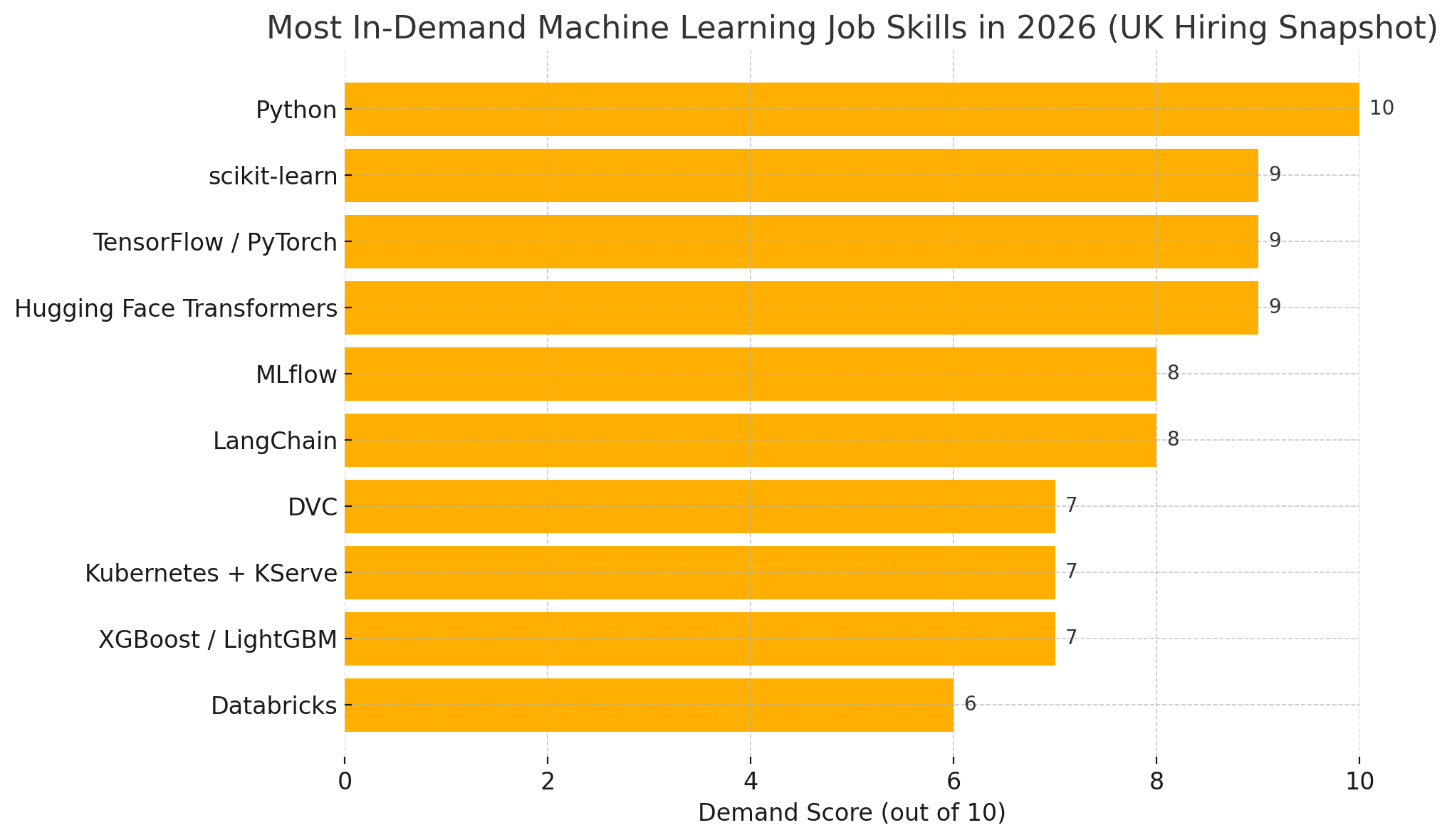
What are the most in-demand UK ML job skills in 2026?
Below is a visual overview of the ML tools, platforms & frameworks UK employers will be hiring for:
How can you future-proof your UK machine learning career in 2026?
Master End-to-End ML
From cleaning data to monitoring models—employers want full lifecycle fluency.Adopt MLOps Tools
Learn MLflow, DVC, containerisation, and deployment workflows.Keep Up with LLMs & Generative AI
Experiment with OpenAI, Hugging Face, LangChain, and RAG architectures.Build a Public Portfolio
Create GitHub projects with full pipelines and dashboards—show you can ship models, not just build them.Engage with UK ML Communities
Join PyData London, AI UK (Turing Institute), MLOps Community, and ML meetups across Bristol, Manchester & Edinburgh.
Where can you find UK machine learning jobs in 2026?
🤖 Head to www.machinelearningjobs.co.uk to browse verified UK ML roles across fintech, medtech, health, AI startups, and enterprise teams. We post roles ranging from Junior ML Engineers to Head of AI.
Conclusion: Your Machine Learning Toolkit for 2026
The future of machine learning is production-ready, collaborative, and LLM-aware. In 2026, successful ML professionals won’t just build models—they’ll ship and scale them, responsibly.
Use this Machine Learning Jobs Skills Radar 2026 to guide your learning path—and revisit each year as we track the UK’s evolving ML hiring landscape.
Subscribe to our newsletter for job alerts, tool comparisons, salary guides & expert career tips.